
The attention span of an average adult is 8.25 seconds. For reference, that’s less than a goldfish, who boasts a whole 0.75 seconds more.
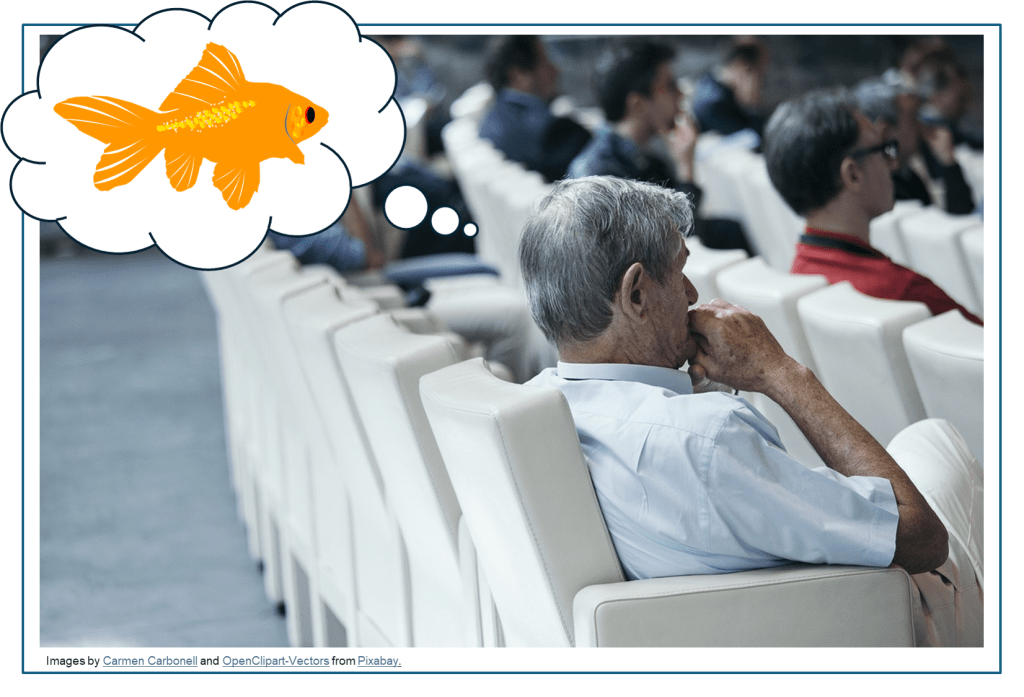
You are probably wondering what it means for your medical education projects? It’s definitely not good news! How do you deliver meaningful educational content when you can lose your audience after just a few seconds?
The shift to digital learning environments has only amplified this challenge. How often did you catch your mind wandering off during a Teams meeting, so that you had no recollection of what was discussed in the last 10 minutes? How about a webinar, even when it was on the topic you are genuinely interested in and want to learn more about?
We are all victims of the current digital age, and what holds true for you, will also apply to healthcare professionals attending your webinar or satellite symposium. They, too, are accustomed to social media style of content delivery in short, snappy videos. They, too, read only every 5th word on a web page, and leave a page on average after meagre 10-20 seconds.
The cost of audience disengagement during a symposium is high: you risk that they miss key concepts and leave the event with incomplete or, even worse, wrong information. Engaged audience retain more information and are more likely to apply what they learned in their daily practice. They will also share their insights with colleagues and come back to your future educational events.
The strategy of any educational webinar or symposium should be to capture attention from the start and sustain audience engagement throughout the entire session. Here are some tactics you can apply to maximise engagement:
1. Move away from a traditional lecture format
An event where a speaker talks uninterrupted for 45 minutes simply doesn’t align with how modern brains processes information. The same applies to an event where three different speakers talk for a sum of 45 minutes.
2. Break your content into digestible chunks
Structure your content in 5-7-minute segments, each focused on a single concept. Use clear transitions and summarise take home messages between segments.
3. Make it interactive
Keep your audience engaged by asking them to answer a polling question or hold up their hands in response to a question every 5-7 minutes. The simplest physical actions your audience is asked to perform facilitate their engagement – it can be as simple as a mouse click. If your event is online, we recommend having a moderated chat: you can use it for the presenters to engage with audience, as well as to encourage peer-to-peer interaction.
4. Build up attention from the start
How often do we lose the audience during the ‘Welcome and introductions’ presentation by the chair, when they take 5-10 minutes to introduce the agenda, the faculty, the logistics, the fire safety rules? It may sound radical, but try cutting it short next time. Start from a thought-provoking question or a controversial topic, and introduce the faculty and the agenda later. Better yet, start with a patient case that healthcare professionals in the room can relate to. But don’t skip fire safety – it’s important too!
5. Create psychological investment
Explain to your audience why your content is important for them. Put yourself in their shoes and ask: why would I want to listen to this? The simplest way to generate psychological investment is to lead with ‘At the end of this session you will be able to…’.
 Parse Medical | Consultancy services for Medical Affairs and Medical Communications
Leave a comment