
If you work in medical communications, you are probably aware of the growing patient-centric trends in healthcare, such as intensifying patient involvement in clinical trial design, inviting patients to be authors on clinical publications and reviewers of the wider range of medical communications.
As an agency, it’s extremely rewarding to work with patients and support them in sharing their needs and experiences, and we all feel lucky when we work on a project that involves direct contact with patients, charities or patient advocacy groups. But we also remember that patient centricity doesn’t stop there. At Parse Medical, our approach is to add small steps to our daily work that, collectively, will amplify the patient’s voice in all our deliverables: starting small while thinking big. You don’t need a large global patient engagement project to deliver work that is ethical, inclusive and patient-centric. Sometimes, when you write about a condition, all you need is to pause and think about the people living with it. Does it play a minor or major role in their life? How does it affect their day? How can we reflect this in the materials we are writing/developing? Is there anything in these materials that can make a difference for the patients and their families?
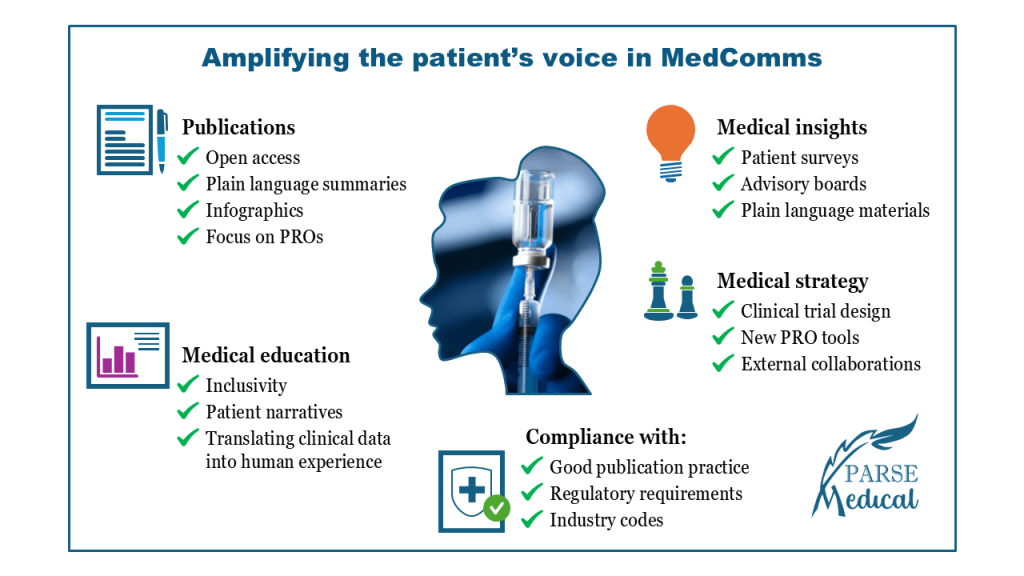
These principles can (and should) be applied across different types of medical communications deliverables, and here are some examples from our experience:
Publications: Making science accessible
- When working on a publication, we will always suggest that our client and authors consider open access publishing options. We routinely offer developing a plain language summary, – needless to say, any offer is aligned with good publication practice (GPP) and the target journal guidelines.
- If the study collected patient reported outcomes (PROs) or patient reported experience measures (PREMs), we suggest including them in the publication.
- We ask the study team whether the study protocol was developed with patient input; if yes, we explore the options of including patient authors in a GPP-compliant way.
- If not already requested by our clients, we discuss with them other options of adapting the publication to lay audiences – for example, by generating an infographic or an author ‘talking head’ video.
- We help our clients navigate the local and regional restrictions on disseminating information related to investigational products and prescription-only medicines.
- We always follow GPP and other guidelines for publication development, for example, use sensitive, inclusive language when describing patient populations (such as guidance on reporting race, age, sex and gender).
Medical Education: Reflecting human experience in the clinical data
- We understand the impact of sharing authentic patient experience in medical education, and we champion the inclusion of patient narratives that bring clinical data to life.
- We treat patient cases with respect and present them in a balanced and inclusive manner, representing diversity while avoiding stereotypes or stigmatisation.
- We check if appropriate consent has been obtained for sharing medical history and anonymise patient information to ensure that individuals cannot be identified.
- Compliance considerations are paramount in these activities. We work closely with clients’ compliance departments align all patient-focused content with regulatory requirements.
Medical Insights: Listening to the patient’s voice
- If we are asked to facilitate a patient advisory board, we help our clients ensure that patient representation is meaningful and patient perspectives are taken on board.
- We help design advisory board formats that enable authentic patient participation, providing appropriate support and preparation to ensure that patient representatives can contribute effectively alongside clinical experts. This might include pre-board briefings, plain language materials, and follow-up summaries that capture patient insights.
Patient-focused market research represents another important area of support. We can help design and conduct studies that explore patient experiences, unmet needs, and treatment preferences. This research provides valuable insights for Medical Affairs teams seeking to understand real-world patient journeys and identify opportunities for improved care.
We also support the development of patient-focused scientific platforms and congress activities, helping to create forums where patient voices can be heard alongside traditional clinical presentations.
Leveraging collaborations
Of course, the approach described above would not be effective if it weren’t aligned with the strategic and tactical priority of our clients. We work closely with pharma Medical Affairs, Scientific Communications and other departments and follow each client’s internal guidelines. Together, we ensure that patients’ insights are reflected in study designs and publications, and the patient’s share of voice is growing across all types of medical communications.
 Parse Medical | Consultancy services for Medical Affairs and Medical Communications
Leave a comment