
It’s been a few years (if not decades) since plain language summaries (PLS) took off as a method of disseminating complex scientific findings to non-specialist audience. Why do we have a feeling that we still haven’t got them quite right?
While the number of journals offering to publish PLS has increased, the concept remains ill-defined. Who exactly are we writing these summaries for? PLS have been historically called ‘patient summaries’ and ‘lay summaries’, so it’s logical to assume that they are aimed at patients and general public, with a secondary target audience of primary care physicians. However, the reality may be slightly more complex.
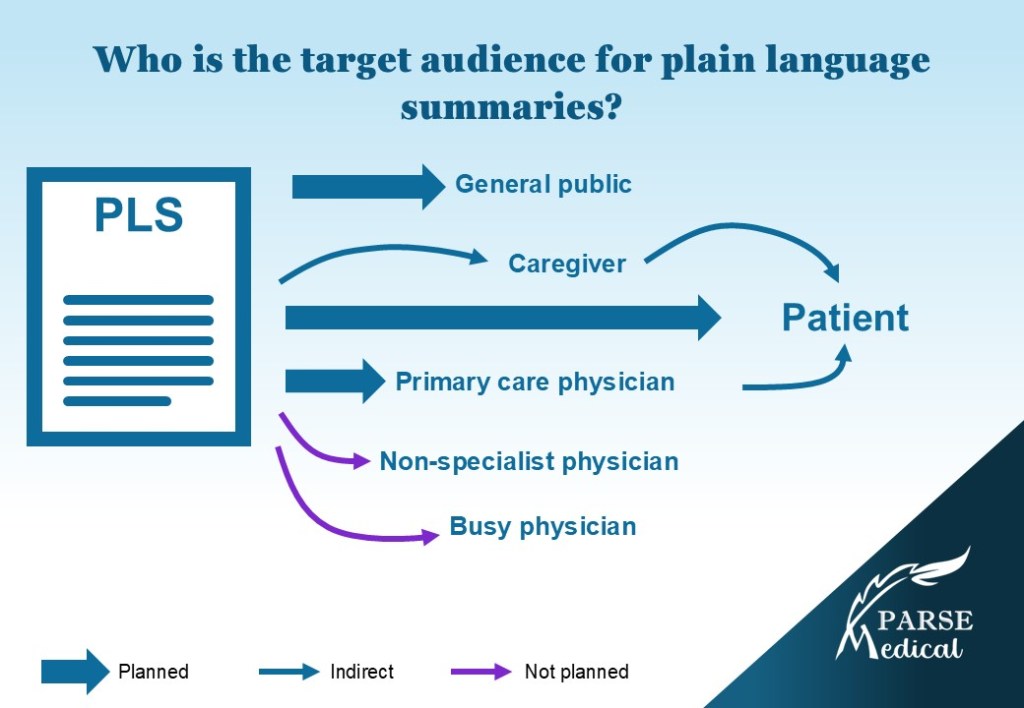
Furthermore, there are no uniform guidelines on how it should be written beyond the instruction to avoid technical jargon. However, no matter what target audience you have in mind, it would be wrong to view the PLS as a simplified version of the abstract. Instead, it should aim to highlight the aspects of the research that are relevant to the reader – this may mean pointing out results that have been omitted from the specialist abstract.
How important are PLS for patients and their caregivers?
In the context of growing amount of health misinformation online, one cannot overestimate the value of having a good PLS in your scientific article. If you ask medical communications professionals, most would agree that PLS is one of the drivers of fair and equal access to medical research outcomes. However, even professionals do not appreciate the true value of PLS until they find themselves on the receiving end. Try asking professionals who are also patients or family members of patients affected by rare conditions – that’s when you will hear that PLS are absolutely indispensable.
For patients, particularly those who received their diagnosis recently, the search for information can feel urgent and frightening. Not everything they find online will be accurate or trustworthy. By providing easy-to-understand summaries of research, we can support them in their search of credible information on their condition.
PLS can also help healthcare professionals keep up with new developments that are outside their immediate field of expertise. By supporting primary care physicians, we are ultimately supporting patients: informed physicians will be better at diagnosis, appropriate referrals, and explaining the latest research to patients.
Should we outsource PLS writing to AI?
Some companies are doing it already; however, we at Parse Medical don’t believe that the current AI tools are useful for generating PLS. Our tests reveal that, while generative AI tools can summarise long documents, they often misinterpret results, omit important information, and lack empathy that is needed when the target audience are patients. Of course, we can get a good PLS out of a chatbot after extensive prompting, revision requests and correction, but achieving a good result may take longer compared with just writing the PLS the old-fashioned way.
Our conclusion
Whether they are aimed at patients or primary care physicians, PLS help disseminate results of research to a wider audience. In our opinion, a PLS is a must-have for every scientific publication.

Leave a Reply